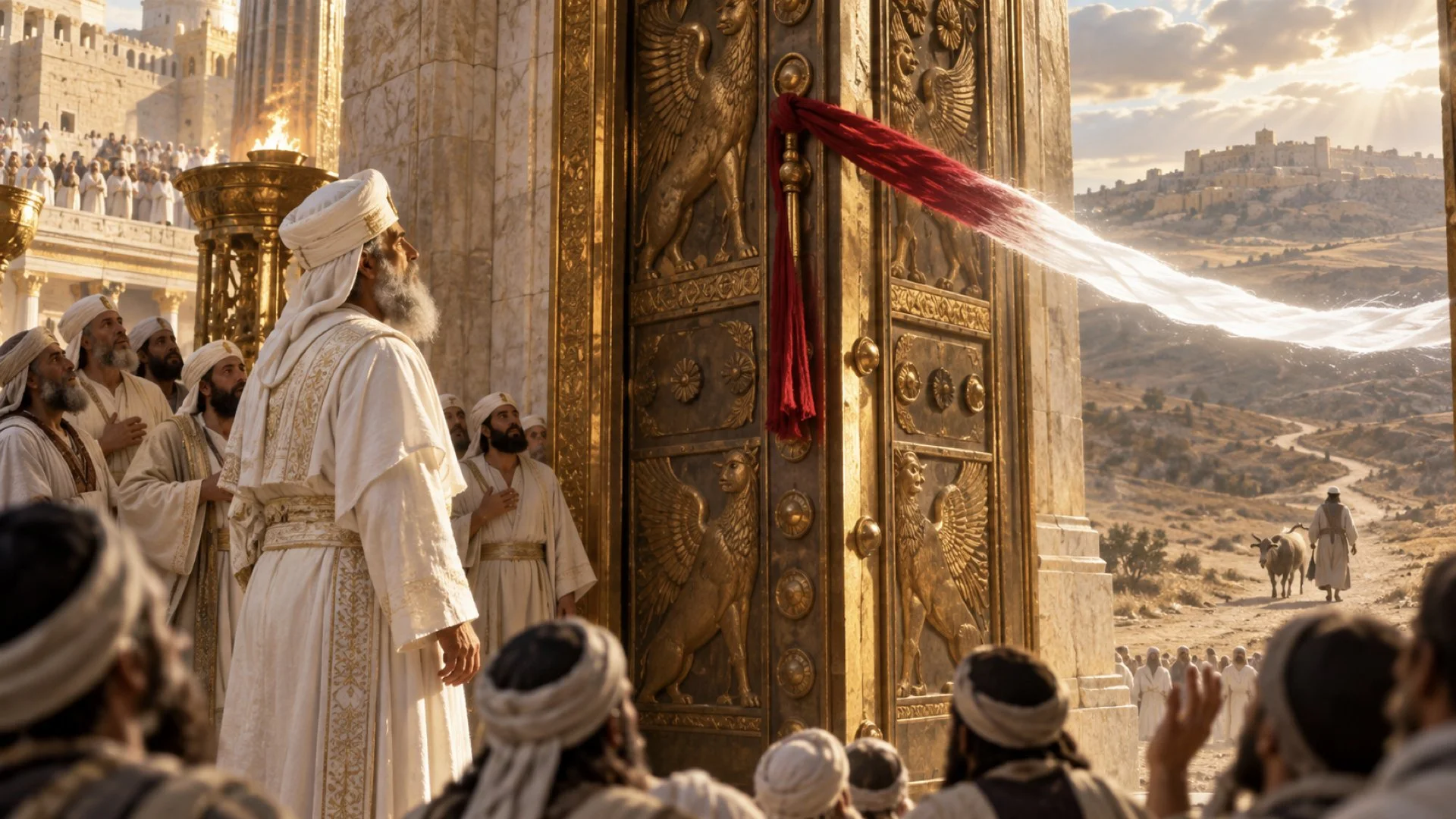
Yom Kippur: A Shadow of Eternal Redemption in Christ and the removal of Sin
Discover how Yom Kippur and its ancient sacrifices foreshadowed the eternal redemption Jesus accomplished through His blood, removing our sinful nature, making us holy, and transforming us into the dwelling place of the Holy Spirit.
Cleansed for His Presence: From Yom Kippur to Eternal Redemption in Christ
How the Day of Atonement Foreshadowed Our New Nature, Eternal Redemption, and Christ's Victory Over Darkness
These two standalone messages explore Yom Kippur, the Jewish Day of Atonement, and how its sacrifices foreshadowed the eternal redemption we have in Jesus Christ. The two goats, the cleansing of the tabernacle, and the ministry of the high priest reveal something greater than temporary forgiveness. They point to the removal of our old sinful nature, our sanctification through the blood of Christ, and our transformation into the dwelling place of the Holy Spirit.
These messages also establish the foundation for our October 2026 series examining the dark spiritual forces operating in the world, including deception, witchcraft, and demonic influences. Before examining darkness, we must establish the supremacy of Jesus, who has conquered death, secured our eternal redemption, and disarmed the powers of darkness.
1. Yom Kippur: The Shadow of Eternal Redemption
When we study the Old Testament, we should always be looking for Jesus. The law, priesthood, sacrifices, and tabernacle were all pointing toward something greater that God would accomplish through Christ. We do not study these things to live under the old covenant but to discover the depth of what Jesus accomplished through His finished work.
Yom Kippur means the Day of Atonement. Under the Mosaic covenant, it was the annual day when the high priest carried out sacrifices and cleansing rituals on behalf of Israel. Leviticus 16 describes the ceremony, while Hebrews 9 and 10 explain how these sacrifices foreshadowed Christ.
To understand atonement, we must understand humanity's greatest problem. We tend to focus primarily on sin, but the deeper problem Jesus came to address was death. God created humanity for life and fellowship with Himself. When humanity turned away from Him, sin entered our experience, bringing spiritual death and separation from the source of life. We could not restore that connection ourselves. God had to remove what separated us from Him, bring us from death to life, and make us capable of being joined to Him eternally.
Leviticus 17:11 tells us that the life of the flesh is in the blood and that God gave the blood upon the altar to make atonement for the soul. The sacrifice represented an exchange of life, temporarily providing for Israel under the old covenant and pointing toward the perfect life Jesus would offer on our behalf.
On the Day of Atonement, the high priest had to wash, put on the prescribed garments, and offer a sacrifice for himself before ministering on behalf of Israel. This foreshadowed Jesus, who lived a perfect, sinless life and was qualified to become our sacrifice. Unlike the Levitical priests, Jesus needed no sacrifice for His own sin.
Central to the ceremony were two goats. One was offered to the Lord as a sin offering, and its blood was taken into the Most Holy Place. The other goat remained alive. The high priest laid both hands upon its head, confessed Israel's sins over it, and sent it away into the wilderness.
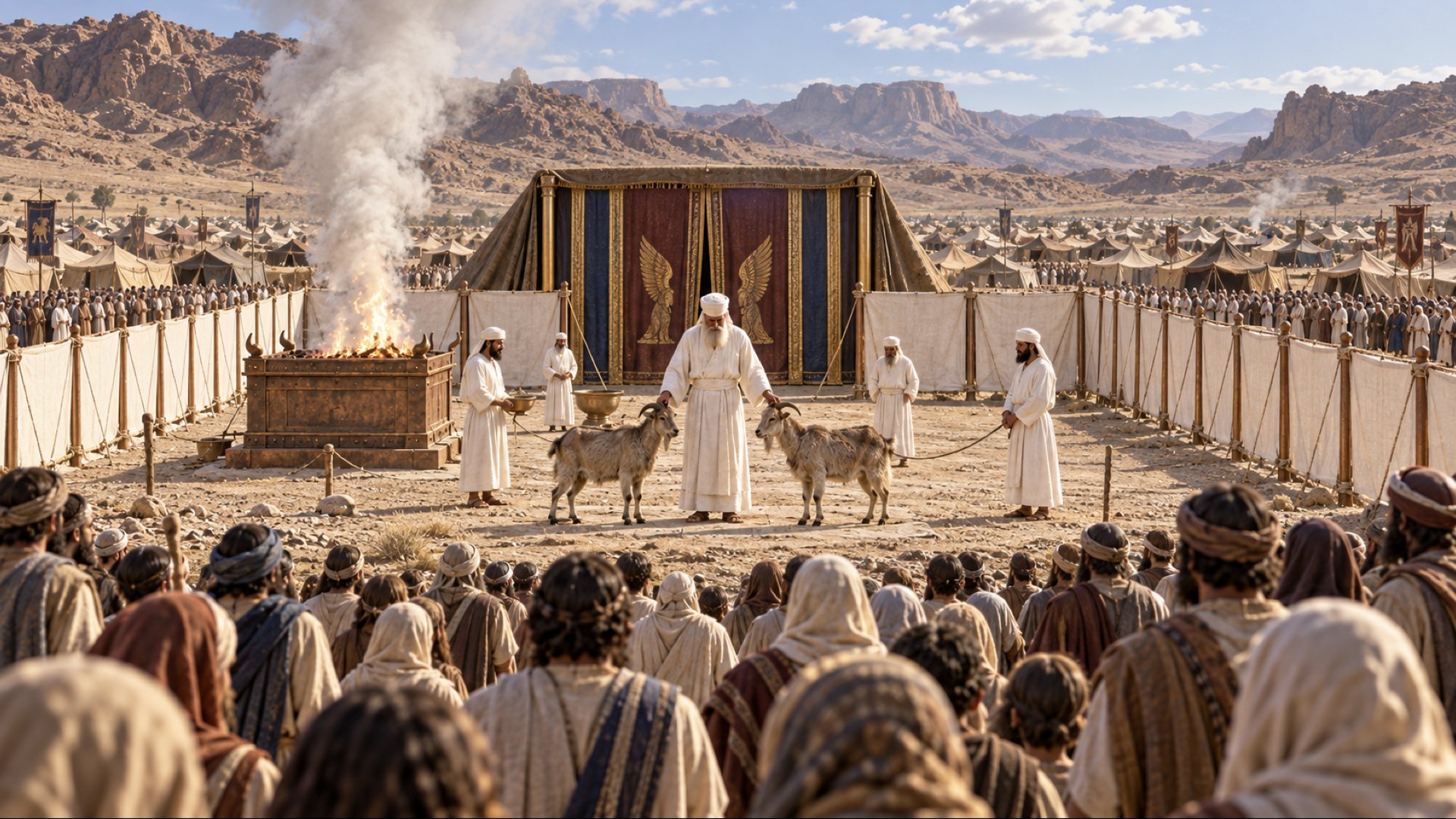
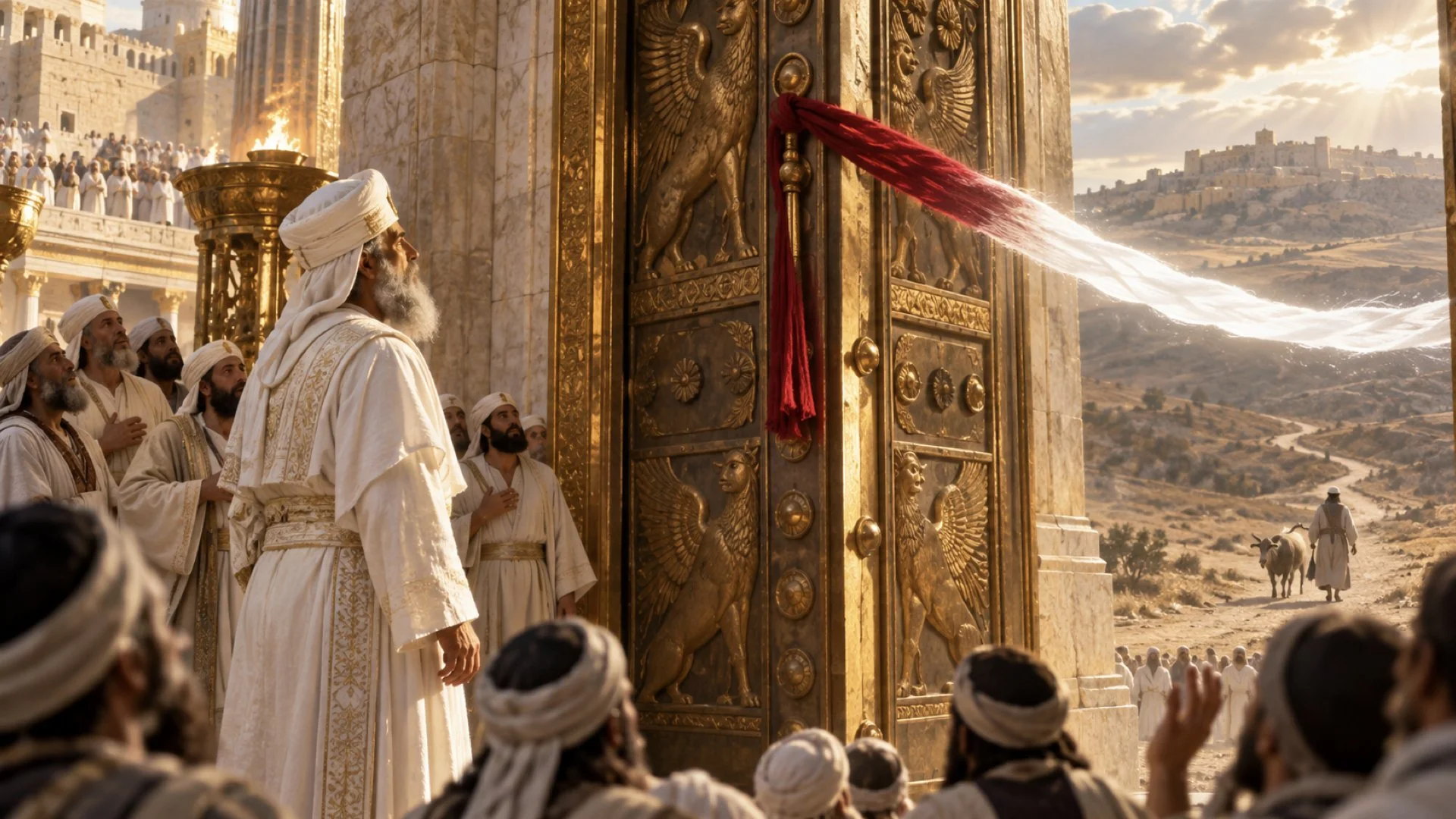
The laying on of hands, associated with the Hebrew term semikhah, represented identification and the symbolic transfer of sin. The two goats together reveal two aspects of Christ's work: the offering of life to deal with sin and its consequences, and the removal of sin from the people.
Second Corinthians 5:21 explains that God made Jesus, who knew no sin, to be sin for us so that we might become the righteousness of God in Him.
David captures the heart of this promise in Psalm 103:10–12, declaring that God has not dealt with us according to our sins or rewarded us according to our iniquities. As far as the east is from the west, so far has He removed our transgressions from us.
What Yom Kippur represented temporarily, Jesus has accomplished eternally.
2. The Blood of Christ: Cleansed and Made Holy Forever
Hebrews explains how Jesus accomplished something infinitely greater than the old covenant sacrifices. Under the law, priests continually offered sacrifices, and the high priest entered the Most Holy Place annually with the blood of animals. These sacrifices served their appointed purpose, but they could never produce eternal redemption or permanently remove sin.
Hebrews 9:11–14 tells us that Christ entered the greater and more perfect tabernacle, not made with human hands, and entered the Most Holy Place once for all by His own blood, having obtained eternal redemption. The blood of animals provided ceremonial cleansing, but the blood of Christ cleanses our consciences from dead works so that we may serve the living God.
Jesus did not merely obtain another temporary covering for sin. His sacrifice secured eternal redemption.
Hebrews 9:24–26 explains that Christ entered heaven itself to appear in God's presence for us. He did not enter to offer Himself repeatedly. He appeared once for all to put away sin through the sacrifice of Himself.
Because He did, we can stand before the Father without guilt. Our conscience can be cleansed because Jesus has dealt with our guilt and given us His righteousness. Romans 5:8–10 reminds us that while we were still sinners, Christ died for us. Having been justified by His blood, we are saved from wrath through Him.
Hebrews 10:14 declares:
"For by one offering he hath perfected for ever them that are sanctified." (KJV)
Sanctification is not something we accomplish through increasingly successful religious performance. We are sanctified through the offering of Jesus Christ. His blood cleanses us and establishes us in a holy state before God. From that holiness, we learn to live in ways that reflect what He has accomplished within us.
We certainly grow in maturity, understanding, and obedience, but we do not progressively earn the spiritual holiness Jesus has already given us.
A cup in the old covenant tabernacle was not holy because it behaved properly. It became holy because it was cleansed and consecrated according to God's instructions. The same principle helps us understand our sanctification. We are made holy through Christ, and then we live from that holiness.
Obedience is the fruit of righteousness, not the means by which we become righteous.
This also changes how we understand repentance. Jesus is not continually offering Himself for every new sin. His sacrifice was offered once, and its effectiveness is eternal. Repentance is a change of mind that brings our thinking and behavior back into agreement with what Christ has accomplished.
Consider the woman caught in adultery in John 8. Jesus removed her condemnation and then instructed her to go and sin no more. Notice the order. Freedom came before responsibility. Grace made a new life possible.
3. The Removal of the Old Sinful Nature: From Death to Life
The second goat on the Day of Atonement provides a profound picture of the removal of sin. The high priest confessed Israel's sins over the living goat, and it carried them away into the wilderness. Under the new covenant, this points toward something even greater than the removal of guilt. It points toward the inward transformation that occurs when someone is born again.
When we receive Christ, God does not simply forgive us and leave us spiritually unchanged. Our old man is crucified with Christ. Our old sinful nature is removed, our spirit is brought from death to life, and we receive a new heart capable of fellowship with God.
Colossians 2 explains that all the fullness of the Godhead dwells bodily in Christ and that we have been made complete in Him, who is the head of all principality and power.
Then Paul describes a circumcision performed without human hands:
"In whom also ye are circumcised with the circumcision made without hands, in putting off the body of the sins of the flesh by the circumcision of Christ." (Colossians 2:11, KJV)
This spiritual circumcision is performed by Christ Himself. The phrase "body of the sins of the flesh" includes the Greek terms sōma, meaning body, and sarx, meaning flesh. Here, we are considering the removal of the old sinful condition that characterized us apart from Christ.
Paul continues by explaining that we were buried with Christ in baptism and raised with Him through faith in the working of God. When we were dead in our trespasses, God made us alive together with Christ, having forgiven all our trespasses.
This is the new birth.
Romans 6 describes our old man being crucified with Christ so that we should no longer be slaves to sin. This is why I teach that the born-again believer does not have two spiritual natures competing for ownership of the same person. God has made you new in Christ.
Believers can still sin. We have bodies with natural desires, minds that need renewing, and learned patterns of behavior. But our failures do not mean the old sinful nature remains our spiritual identity.
Ephesians 4:22–24 instructs us to renew our minds and put on the new man, which was created according to God in righteousness and true holiness. Notice that the new man has already been created in righteousness and holiness.
We renew our minds to express what God has already accomplished within us. When facing temptation, the answer is not to persuade ourselves that we remain spiritually corrupt. The answer is to remember who we have become in Christ and allow His grace to strengthen us to live accordingly.
4. Cleansed for His Presence: You Are Now the Temple of God
One of the remarkable dimensions of the Day of Atonement was the extensive cleansing required for the tabernacle and its furnishings. The sanctuary was the appointed dwelling place of God's presence among Israel.
Under the new covenant, God dwells within those who have been born again.
First Corinthians 6:19 reminds us that our bodies are the temple of the Holy Spirit who is in us. Everything the high priest did to prepare the sanctuary for God's presence was pointing toward something God would eventually accomplish within us.
We can draw several meaningful parallels between the tabernacle and the work of Christ. The bronze altar reminds us that our old man was crucified with Christ. The bronze laver points toward our washing and regeneration. The golden lampstand illustrates our spirit being brought from darkness into life. The table of showbread reminds us that Christ is our life and spiritual sustenance.
The altar of incense pictures the new heart God has given us, capable of fellowship with Him. The Ark of the Covenant points toward the indwelling presence of God. The sanctuary as a whole illustrates the believer being set apart as God's dwelling place, while the holy vessels remind us that we have been cleansed and consecrated for His purposes.
These are illustrations rather than exact one-to-one interpretations, but they reveal the many dimensions of our redemption.
Ezekiel 36:26–27 contains the remarkable promise that God would give us a new heart, place a new spirit within us, remove the heart of stone, and put His own Spirit within us.
Through the new birth, the believer becomes the dwelling place of the Holy Spirit. As we yield to Him and are filled with the Spirit, His power, wisdom, and gifts can be expressed through our lives for the glory of Christ.
The Christian life is not simply an attempt to imitate Jesus through willpower. It is the life of Christ being expressed through someone transformed inwardly and joined to Him by the Spirit.
This should change how we think about ministry. We are not simply accumulating Bible knowledge for ourselves. We are being equipped to carry Jesus into the world.
Do not allow imperfect performance to convince you that you are disqualified from being a light to someone else. The Spirit of God lives within you, and you have more to offer than you may realize.
You are a living temple, carrying the presence of God wherever you go.
5. Jesus Is Supreme: His Victory Over Darkness Is Our Foundation
All of this establishes the foundation for our October series: Jesus has conquered death, secured our redemption, and disarmed the powers of darkness.
Before studying demonic activity, spiritual deception, witchcraft, or occult practices, we must establish the supremacy of Christ. Otherwise, we can easily approach these subjects from fear or an exaggerated view of the enemy's power.
Colossians 2 brings together the inward transformation of the believer and Christ's victory over spiritual authorities. Paul explains that we have been made complete in Christ, describes the removal of our old sinful condition, and declares that Jesus canceled the record of debt against us, nailing it to His cross.
Then he writes:
"And having spoiled principalities and powers, he made a shew of them openly, triumphing over them in it." (Colossians 2:15, KJV)
The same cross that secured our forgiveness and removed our old sinful nature was also the means by which Jesus triumphed over the powers of darkness.
Jesus declared in Matthew 28:18 that all authority had been given to Him in heaven and on earth. Revelation 1:18 presents Him as the one who was dead and is alive forevermore, holding the keys of death and Hades.
He has authority over heaven, earth, death, and the grave.
This does not mean evil no longer operates in the world. Scripture warns about spiritual wickedness, deception, and the strategies of the devil. But these powers are not equal competitors with Jesus. They are defeated powers operating in a world where Christ's victory has already been established.
Our responsibility is not to become fascinated with darkness or frightened by evil. It is to become fully persuaded of who Jesus is, what He accomplished, and who we have become in Him.
As we examine witchcraft, New Age teachings, spiritual manipulation, and attempts to control outcomes apart from God, we must remember that our completeness is already found in Christ. Even prayer can become distorted when used to force an outcome rather than commune with God and trust His wisdom.
Our authority comes from Him. Our righteousness comes from Him. Our holiness comes from Him. Our freedom from condemnation comes from Him.
And the ultimate evidence of spiritual maturity is love. The purpose of redemption is not simply to make us powerful. It is to restore us to the Father and allow His love and life to be expressed through us.
We are not studying darkness to discover whether Jesus has enough power to overcome it. We are studying these things because Jesus has already triumphed, and we need to understand how to stand in the authority and freedom He has given us.
Bible Study Homework and Practical Application
I encourage you to study these truths for yourself and allow the Holy Spirit to illuminate what Jesus has accomplished.
Your primary homework is to read Leviticus 16 and the entire book of Hebrews. Leviticus 16 describes the Day of Atonement, while Hebrews explains how Jesus fulfilled and surpassed the old covenant sacrificial system through His once-for-all sacrifice.
Before reading Hebrews, I recommend watching the two overview videos from BibleProject, which provide helpful context. You can read or listen to Hebrews in one sitting, then revisit it over the next couple of weeks.
For a deeper understanding, I also encourage you to work through my Book of Hebrews Course at Forward School of Transformation. This course will help you understand the superiority of Jesus, the new covenant, His priesthood, and the eternal redemption secured through His finished work.
As you study, meditate on Hebrews 9:26, which declares that Jesus appeared once for all to put away sin through the sacrifice of Himself. Ask the Holy Spirit to reveal what that means for your identity, your conscience, and your relationship with God.
For a practical exercise, consider an area where you struggle with temptation, guilt, or fear. Rather than beginning with your failure, begin with what Jesus has accomplished. Ask yourself: Who am I now in Christ? Has Jesus already dealt with this? Am I responding as someone still trapped in sin or as someone Christ has made free?
Finally, take time to acknowledge the Holy Spirit within you. Make these truths personal:
I am redeemed through the blood of Christ. I am forgiven, righteous, sanctified, and holy through Jesus. My old sinful nature has been removed. I have a new heart and have been made alive in Christ. The Holy Spirit dwells within me. I am complete in Christ, and He is supreme over every principality and power.
The Day of Atonement was the shadow. Jesus is the substance. The old covenant anticipated a greater cleansing, a better sacrifice, and eternal redemption. Through His death, burial, and resurrection, Jesus accomplished it all.
You have been cleansed for His presence, made holy through His blood, and brought into eternal union with Him. Now live from the freedom, righteousness, and authority He has given you.

How to Hear God
Hearing God becomes clearer as you know His character, renew your mind with His Word, and become established in who you are in Christ. As your inward beliefs come into agreement with your new identity, you become more sensitive to the Spirit’s leading and more confident in recognizing God’s voice in everyday life.
Learning to Think Like the New You
Hearing God is not supposed to be a mysterious experience reserved for unusually spiritual people. Jesus described hearing His voice as normal for those who belong to Him.
John 10:27 My sheep hear My voice, and I know them, and they follow Me.
Jesus did not say, “My prophets hear My voice,” or, “My apostles hear My voice.” He said, “My sheep hear my voice.” Hearing God begins with identity. You hear Him because you belong to Him.
Through Christ, you have already been reconciled to God, made alive spiritually, given a new heart, and joined to the Holy Spirit. You are not trying to become spiritual enough for God to communicate with you. The real issue is learning to recognize the God who already lives within you.
That begins with knowing who He is, knowing who you are in Him, and allowing those truths to reshape the way you think.
Paul describes one of the primary ways God communicates with believers.
Romans 8:15 For you did not receive the spirit of bondage again to fear, but you received the Spirit of adoption by whom we cry out, “Abba, Father.” 16 The Spirit Himself bears witness with our spirit that we are children of God, 17 and if children, then heirs—heirs of God and joint heirs with Christ, if indeed we suffer with Him, that we may also be glorified together.
The Holy Spirit bears witness with our spirit. There is an inward knowing that goes deeper than intellectual reasoning. God communicates heart to heart and spirit to spirit.
Notice the first thing the Spirit bears witness to: who we are. Before the Spirit gives direction about jobs, relationships, ministry, or decisions, He establishes identity. You are a child of God.
That matters because your sense of identity affects how you interpret what you hear. If you see yourself as condemned, rejected, powerless, or constantly disappointing God, those beliefs will shape your perception of His voice. But the Holy Spirit continually bears witness to a different reality: you belong to the Father, you have been accepted in Christ, you have been made righteous, and you have become His dwelling place.
You are not an outsider trying to obtain access. You are a son or daughter learning to recognize the voice of your Father.
Renew Your Mind and Discern His Will
Romans 12 makes the connection between renewed thinking and spiritual discernment very clear.
Romans 12:2 And do not be conformed to this world, but be transformed by the renewing of your mind, that you may prove what is that good and acceptable and perfect will of God.
We often separate renewing the mind from hearing God, but Paul connects them. As your mind is renewed, you become able to discern the will of God. The word translated “prove” carries the idea of testing, recognizing, and approving what is genuine.
A renewed mind becomes increasingly able to recognize what agrees with God.
This is one of the greatest keys to hearing Him. When you begin thinking like Him, His voice becomes recognizable.
The principle is simple. The more closely you know someone, the easier it becomes to recognize what sounds like them. The same is true with God. As you become established in His character as revealed in Jesus, you begin to know instinctively what agrees with Him and what does not.
You know God is good. You know God is love. You know what Jesus accomplished at the cross. You know you have been reconciled to Him. You know His Spirit produces love, joy, peace, patience, kindness, goodness, faithfulness, gentleness, and self-control.
So when a thought comes saying, “God is finished with you,” or, “You have failed too badly,” you do not need to wonder whether that thought came from Him. It does not agree with Jesus, the gospel, your identity, or the finished work of the cross.
At the same time, when something rises within you that carries truth, love, wisdom, peace, courage, righteousness, or a desire to bless someone, you learn to pay attention. The renewed mind becomes sensitive to the language of the Spirit.
Put On the New Man
Paul describes the same process in Ephesians.
Ephesians 4:20 But you have not so learned Christ, 21 if indeed you have heard Him and have been taught by Him, as the truth is in Jesus: 22 that you put off, concerning your former conduct, the old man which grows corrupt according to the deceitful lusts, 23 and be renewed in the spirit of your mind, 24 and that you put on the new man which was created according to God, in true righteousness and holiness.
You have already been made new in Christ. Paul is not telling you to create a new identity. The new man already exists and has been “created in righteousness and true holiness.”
The issue is learning to think consistently with who you have become.
You are who you are in spirit. Now put that identity on in your thinking. Begin seeing yourself as righteous in Christ, filled with the Holy Spirit, capable of resisting temptation, equipped with wisdom, loved by God, and able to hear Him.
As those truths move from theological information into heart-level belief, your perception changes. And when your perception changes, your hearing changes.
Your beliefs function like a lens. Two people can experience the same situation and interpret it completely differently because of what they already believe internally. The same thing happens spiritually.
If you believe God is constantly disappointed with you, correction may sound like rejection. If you believe He is unpredictable, silence may feel like abandonment. If you believe you are powerless, an opportunity may feel like a threat.
But when your heart becomes established in the finished work of Jesus, your interpretation changes. Correction becomes loving direction from a Father rather than condemnation from a judge. Temptation becomes something contrary to your true nature rather than evidence of who you really are.
You begin to recognize, “That is not who I am.”
When your inward thoughts and feelings begin to agree with your true spiritual identity, the distance between who you are and how you experience yourself begins to disappear. You start living more naturally from what God has already made true.
Hearing God Becomes Natural
Hearing God becomes much less complicated when you stop approaching Him like a stranger trying to intercept secret information and begin living in relationship.
Jesus said His sheep hear His voice. Romans says His Spirit bears witness with our spirit. Paul says the renewed mind can discern the will of God. Ephesians says to put on the new man who has already been created in righteousness and true holiness.
These truths belong together.
Identity affects thinking. Thinking affects perception. Perception affects discernment. Discernment affects choices. Those choices shape the life you experience.
You are who you are in spirit. Put on that mindset and it will shift your thinking. When your thinking shifts, your hearing shifts. When your hearing shifts, your choices begin to change, and increasingly the kingdom of God becomes established in the practical areas of your life.
God Has Remade You for Communion With Him
Paul says:
Ephesians 2:10 For we are His workmanship, created in Christ Jesus for good works, which God prepared beforehand that we should walk in them.
You are His workmanship. Something real happened to you in Christ. You were made alive. You received a new heart. You received the Holy Spirit. You became God’s dwelling place.
God has remade you for communion with Himself. You were recreated to know Him, walk with Him, hear Him, and express Him.
Jesus said:
John 16:13 However, when He, the Spirit of truth, has come, He will guide you into all truth; for He will not speak on His own authority, but whatever He hears He will speak; and He will tell you things to come.
Guidance is part of the ministry of the Holy Spirit, but it often feels more natural than people expect. It can come through an inward knowing, a Scripture coming alive in your heart, a recurring idea, a sense of restraint, compassion for another person, an increasing confidence about a direction, or a check inside when something does not seem right.
The goal is not to become obsessed with the mechanism. Know the Person. The better you know Him, the easier it becomes to recognize what comes from Him.
Hearing God should not be reduced to chasing a feeling of peace. Peace matters, but obedience does not always feel comfortable. Courage can stretch us, and God may lead us into situations that require faith.
The better question is whether something agrees with God’s nature, God’s Word, the finished work of Jesus, and who you have become in Christ.
You are not supposed to obey every thought that enters your mind. You are learning to shepherd your thoughts. Does this agree with love, truth, wisdom, and righteousness? Does it agree with what Jesus has revealed about the Father? Does it agree with my identity in Christ? Does it produce the fruit of the Spirit?
Over time, discernment becomes increasingly intuitive because your mind has been trained by truth.
Grace Empowers You to Follow What You Hear
Hearing God is not merely about receiving information. It is about participation.
Paul writes:
Philippians 2:13 for it is God who works in you both to will and to do for His good pleasure.
God is working in you, shaping both desire and action. When the Spirit leads you toward patience, generosity, courage, purity, kindness, prayer, or obedience, He is not simply giving you an instruction and leaving you alone to accomplish it. His grace is available to empower the response.
This changes how you approach temptation as well. Instead of saying, “I am a sinful person trying desperately not to sin,” you can respond, “I am righteous in Christ. I am a temple of the Holy Spirit. This temptation does not reflect who I really am, and God’s grace is present to empower me to live from my true nature.”
You are not trying to become righteous through resistance. You resist because righteousness is already your identity.
The more consistently you live from that identity, the more sensitive you become to the Spirit’s leading.
Stop Trying So Hard to Hear
Sometimes desperation to hear God makes discernment more difficult. We analyze every thought: “Was that God? Was that me? Did I miss Him?” Fear creates internal noise, but relationship creates confidence.
God is your Father. You belong to Him. His Spirit lives within you. He knows how to communicate with you.
Rest in Christ. Remember who you are. Turn your attention toward Him. Fill your heart with truth. Expect His wisdom, and make decisions from faith rather than fear.
Sometimes you may have an unmistakable direction from the Lord. Other times you may simply have wisdom, peace, freedom, and the ability to choose. Both can be spiritual.
The goal is not to become dependent on supernatural instructions for every small decision. The goal is to become so established in God that His wisdom becomes increasingly natural to the way you think.
Practice Thinking Like the New You
One of the simplest ways to grow in hearing God is to practice thinking like the person God has already made you.
Remind yourself that you are God’s child, that you have been reconciled to Him, that His Spirit lives within you, that you have a new heart, that you are righteous in Christ, that wisdom is available to you, and that you can hear your Shepherd.
Then pay attention without anxiety. Notice the thoughts that carry love, wisdom, generosity, compassion, courage, and truth. Notice the inward restraint that tells you not to say something. Notice the prompting to encourage someone. Notice Scripture rising in your heart. Notice ideas that consistently align with God’s nature and purposes.
Then respond.
Discernment grows through relationship and use. You learn the voice of the Shepherd by walking with the Shepherd.
Heart to Heart, Spirit to Spirit
The New Covenant is not God standing outside of you shouting directions. God has come to live within you.
His Spirit bears witness with your spirit. He renews your thinking. He reveals Jesus. He reminds you of truth. He produces His character within you. He leads you.
The more your inward beliefs about yourself become consistent with your true identity in Christ, the less internal contradiction there is between your spirit and your thinking, and hearing becomes clearer.
You stop interpreting God through shame, fear, or religious performance. You begin recognizing the Father through the revelation of Jesus Christ.
You know who He is. You know who you are in Him. And because you increasingly think like Him, you recognize His voice within your heart.
The progression is simple: know who God is, know who you are in Christ, put on the new man, renew your mind, recognize His voice, respond to His grace, and walk it out.
You are who you are in spirit. Put on that mindset, and it will shift your thinking. Your thinking will shift your hearing. Your hearing will influence your choices. And your choices will increasingly bring your outward life into agreement with the person God has already made you inwardly.
You are His workmanship. You have been recreated for communion with Him. You have a new heart. His Spirit lives within you.
Jesus said, “My sheep hear my voice.”
Believe Him. Practice thinking like the new you, and watch how much easier it becomes to recognize the leading of the Lord in your life.
This version keeps the theology intact but removes a lot of repetition and punch-line formatting, so it should work better as a website article or blog post.
This book will help you know Him and how He feels about you, which will help you become more receptive to His leading in your life.
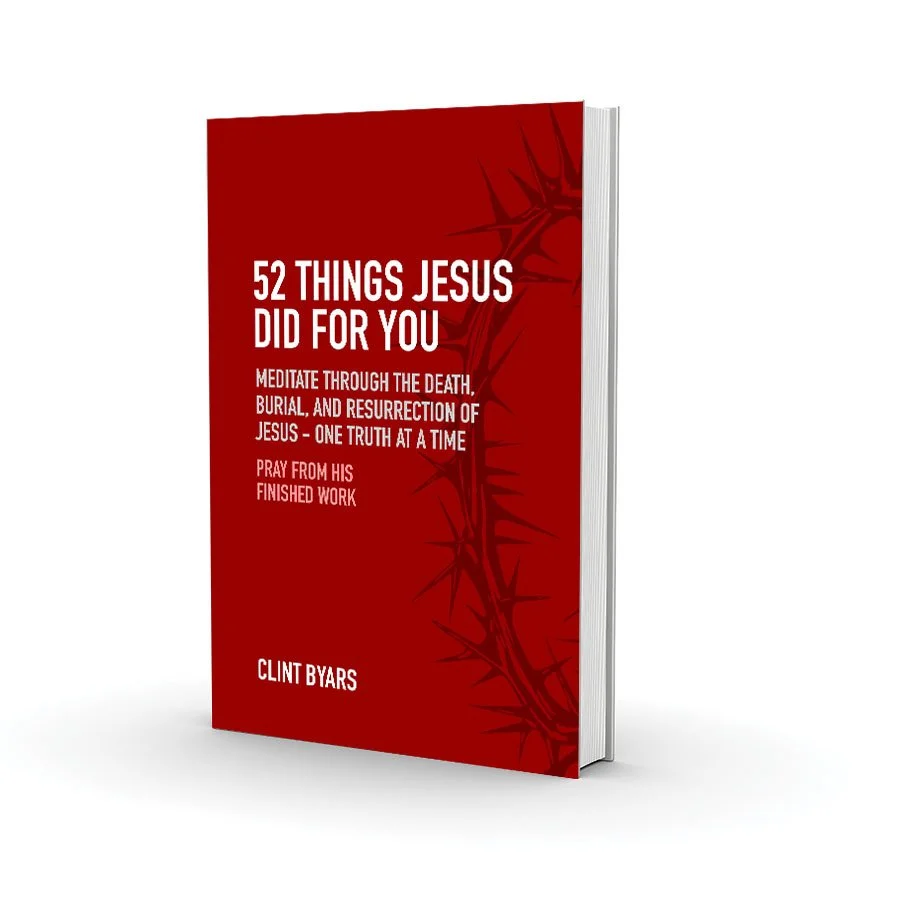
Meditate Through the Death, Burial, and Resurrection of Jesus - One Truth at a Time
52 Things Jesus Did for You is a powerful collection of gospel truths designed to help you fully grasp what Jesus accomplished—and what that means for you. Each entry reveals something Jesus did through His finished work on the cross and invites you to believe it, speak it, feel it, and live it.
This is not a devotional you check off day by day. It’s a resource you return to again and again—a tool for meditation, encouragement, and personal renewal. Whether you explore one truth a day or revisit a single entry for weeks, this book is meant to meet you right where you are.
Inside you’ll find:
52 finished works of Jesus, each rooted in Scripture
Practical affirmations to help renew your mind
Spirit-led prayers and reflection prompts
A small group guide for deeper conversations and shared transformation
These aren’t just theological insights—they are living, powerful truths that change how you see yourself, your circumstances, and your place in God’s story.
Use this book to plant truth, persuade your heart, and walk confidently in the identity Jesus secured for you.
CLICK HERE to Purchase Audiobook, Hardback, Paperback, or Kindle
Mixing Faith with God's Spoken Promise
What you focus on shapes what you see, and when you continually complain about what’s wrong, you can become blind to God’s provision and even begin to loathe the manna at your feet. Instead of letting the snakes of life consume your attention, mix God’s promises with faith, keep your eyes on Jesus, sow gratitude, and let love—not spiritual elitism—be the true measure of your maturity.
The children of Israel wandered through the wilderness surrounded by the supernatural provision of God. He had delivered them from slavery in Egypt, led them by cloud and fire, provided water in the desert, and fed them every single morning.
Then in Numbers 21:5 they said:
“Our soul loatheth this light bread.”
They were talking about manna.
Every morning they woke up, walked outside their tents, and the food was already there. God was daily providing for them in the wilderness, and somehow they had become bored with the miracle.
That is the danger of familiarity.
The manna was pointing to Jesus, the Bread of Life. Israel received bread that sustained their bodies daily, but Christ sustains us eternally. And just as they began to take the manna for granted, we can begin to take Jesus for granted.
Think about what God has done for us. The most powerful Being who exists loves you. He moved heaven and earth to save you. Christ became flesh, died for you, became your sin and the curse, rose again, delivered you from the power of darkness, cleansed you, gave you a new heart, joined His Spirit to you, and gave you eternal life.
And somehow we can still say, in effect, I’m bored.
I need a revival. I need another word. I need another revelation. I need somebody more anointed. I need something to make me feel spiritually alive again.
Meanwhile, Jesus is still the Bread of Life, daily providing for us.
Mixing Faith with the Word
Sometimes we do not need something new. We need to become amazed again by what we already have.
Hebrews 3 looks back at Israel’s wilderness experience and says that they hardened their hearts and could not enter in because of unbelief. Hebrews 4:2 explains why:
“The word preached did not profit them, not being mixed with faith in them that heard it.”
God had spoken to them. He told them He would bring them into the land, drive out their enemies, establish them there, and make them a blessing.
They had the word.
They simply did not mix it with faith.
Instead, they mixed their circumstances with complaining.
The longer they rehearsed what was wrong, the more what was wrong became all they could see. Complaint does not merely describe your experience. Over time, it trains your attention.
What you repeatedly focus on trains what you notice.
If you continually rehearse lack, frustration, disappointment, offense, and everything other people are doing wrong, you can eventually be surrounded by God’s provision while believing He is not providing.
Israel was eating supernatural bread while saying, “There is no bread.” That is how distorted complaint can make our perspective.
We have to stop interpreting God’s will through the lack in our lives. God’s character must interpret our circumstances. Our circumstances do not get to redefine God’s character. He is good. He is a good Father. His heart toward us has been revealed in Christ, and the cross has already settled that question.
When fiery serpents came among Israel, God told Moses to lift up a bronze serpent. Anyone who looked at it lived.
Jesus later said in John 3:14–15:
“And as Moses lifted up the serpent in the wilderness, even so must the Son of man be lifted up: that whosoever believeth in him should not perish, but have eternal life.”
The serpent was a shadow. Jesus is the fulfillment. They looked and lived.
We look to Christ and receive life.
And in John 12:31–33, Jesus again spoke of being lifted up in the context of judgment and His coming death. The cross is where sin, judgment, the curse, and death came upon Christ.
So when circumstances get loud, look at Jesus. When disappointment starts hardening your heart, look at Jesus. When you feel like God has forgotten you, look again.
Stay with the finished work of Christ long enough for it to stir you again.
Hebrews 4 says that “we which have believed do enter into rest,” and that “there remaineth therefore a rest to the people of God.”
This changes the posture of the Christian life.
Many of us came from versions of Christianity that kept us feeling like something was always missing. We needed the next revival, the next conference, the next anointed teacher, the next revelation, the next breakthrough, or another level of holiness.
Our pursuit of God was often driven by lack.
But Christ satisfies.
That does not mean we stop pursuing Him. It means we pursue Him from a different place. We are not pursuing Him to become complete. We pursue Him because we are complete in Him. We are not worshiping to get Him to come near. We worship because He has already joined Himself to us.
We are not looking for the missing ingredient that will finally make Christianity work. We are learning to live from what Christ has already finished.
There can still be hunger, but it is not the hunger of emptiness. It is the hunger of gratitude.
You can be satisfied and still want to know Him more. You can be full and still have an appetite.
And sometimes what we call spiritual hunger may not mean we need God to put something else into us. Sometimes it means it is time to pour out what He has already placed within us.
Love somebody. Encourage somebody. Pray for somebody. Serve. Give. Teach. Share Christ. Use your gifts.
Maybe you are not empty. Maybe you are full.
Jesus is not merely the beginning of Christianity before we move on to something deeper.
He is the depth.
He is the Bread of Life, daily sustaining us. He is our righteousness, our peace, our life, and our union with God.
So keep pursuing Him. Keep growing. Keep believing. Keep mixing faith with what He has spoken.
But do it from rest.
Do it from fullness.
Do it from gratitude rather than complaint.
Don’t get bored with the Bread of Life. Look again at Jesus, remember how good He is, and let Christ satisfy your soul.
What area of life do you find yourself complaining about where Jesus has already provided a promise for you to stand on? And how will you renew your mind to not become bored with his daily life?
Are You Ready?
What if the biggest thing standing between you and God's purpose isn't a lack of faith, but a life filled with distractions? Discover how renewing your mind with God's wisdom prepares you to recognize the divine opportunities He places in front of you every day—and to respond with confidence instead of hesitation.
What if the biggest thing standing between you and God's purpose isn't a lack of faith, but a life filled with distractions?
God has divine appointments for you.
There are people you will meet, conversations you will have, and moments when something rises in your heart and you realize, I need to say something. I need to encourage this person. I need to pray for them. I need to help.
The question is: Will you be ready when the moment comes?
Being ready isn't necessarily about becoming better at hearing God speak in perfectly formed sentences. I don't spend my life trying to get God to give me a detailed set of instructions for every decision I make. I would rather live in a place of inward peace—full of faith, hope, expectation, and love—and trust that as I walk with Him, He is leading me.
When you're inwardly free from distraction, you can become sensitive to what God is doing around you.
You might feel prompted to go somewhere, call someone, encourage your spouse, speak to a server, pray for someone, give something away, or simply say the thing that's already in your heart.
Those moments may seem small, but you don't know what God can do through one moment of obedience.
What's Distracting You?
Hebrews 12 tells us:
“Wherefore seeing we also are compassed about with so great a cloud of witnesses, let us lay aside every weight, and the sin which doth so easily beset us, and let us run with patience the race that is set before us,
Looking unto Jesus the author and finisher of our faith...”
—Hebrews 12:1–2 KJV
Notice that Scripture distinguishes between weights and sin.
Not everything distracting you is necessarily sinful. Some things are simply weighing you down.
It might be your finances. Your health. Something happening at home. A relationship. An unresolved emotional issue. Fear. Shame. Exhaustion. Or it may be a sin that continues to entangle you.
Whatever it is, ask yourself:
What is taking me out of the game?
What is consuming so much of my emotional energy that I'm not present anymore? What keeps me so preoccupied with myself that I don't notice the person God has put right in front of me?
Identify it.
Then ask the harder question:
What am I going to do about it?
Don't Just Hear the Truth—Make a Plan
I don't want us to simply hear good sermons. I don't want us to know a lot of truth and never actually change.
If something continually keeps you stuck, develop a plan.
If you need counseling, get counseling. If your finances are constantly creating chaos, learn how to manage your finances. If you're trapped in destructive patterns of thinking, renew your mind. If you're struggling with a particular sin, get Scripture specifically related to that area and begin seeing yourself through the finished work of Christ.
Talk to somebody you trust. Pray with somebody. Read something. Get help.
Do something. Take a step.
You may have tried 97 times already. Try again—but this time don't approach the problem from condemnation. Approach it from your identity in Christ.
You aren't trying to change so God will accept you.
You are changing because He already has.
You Are God's Workmanship
Ephesians 2:8–10 says:
“For by grace are ye saved through faith; and that not of yourselves: it is the gift of God:
Not of works, lest any man should boast.
For we are his workmanship, created in Christ Jesus unto good works, which God hath before ordained that we should walk in them.”
—Ephesians 2:8–10 KJV
You are God's workmanship.
Your righteousness isn't the product of your perfect behavior. God did something in you through Christ. You have been recreated in Him.
But notice what follows salvation by grace: good works.
We aren't saved by good works. We are recreated for good works.
Grace shouldn't make us passive. Knowing that we are completely free from condemnation should make us some of the most productive, courageous, loving people on the planet.
God has made doing good our way of life.
You Don't Have to Be Paralyzed by Every Decision
Sometimes Christians become so concerned about finding God's exact will that they become afraid to do anything.
Is this God's will?
Am I hearing Him correctly?
What if I make the wrong decision?
There are certainly moments when God leads us toward something very specific. But you don't have to live terrified that one wrong turn will take you outside His ability to lead you.
God is incredibly creative.
You may do something differently than I would do it. Someone else may approach the same opportunity another way. Yet God can work through all of us.
You get to be you.
The bigger question is: What condition is your heart in while you're making the decision?
Are you walking in peace?
Are you full of hope?
Are you expecting God's goodness?
Are you motivated by love?
Do you have a clear conscience before Him?
If so, make a decision and move forward.
A Clear Conscience Is Invaluable
Peter writes:
“But sanctify the Lord God in your hearts: and be ready always to give an answer to every man that asketh you a reason of the hope that is in you with meekness and fear:
Having a good conscience...”
—1 Peter 3:15–16 KJV
There it is again:
Be ready.
A clear conscience before God is invaluable because shame makes us pull away from Him.
Sin does not undo what Christ accomplished or suddenly detach a believer from Christ, but sin can affect our confidence. Shame can make us withdraw emotionally. We hide internally just like Adam hid among the trees.
That's one reason we don't want sin dominating our lives.
Not because we're desperately trying to keep God happy with us.
Christ already dealt with condemnation at the cross.
We want freedom because we have a God to represent.
We want enough inward peace that when God gives us an opportunity to love somebody, encourage somebody, forgive somebody, pray for somebody, or share the gospel, we're available.
Look at Jesus
So how do we change?
Hebrews gives us the answer:
“Looking unto Jesus.”
And then:
“Consider him...”
Again and again, transformation comes back to seeing Him.
The areas where we're still struggling are often the areas where we don't yet see God clearly. As we see Him rightly, we are transformed into His image.
That's why the death, burial, and resurrection of Jesus are so central.
Look at the cross and see what God thinks about you.
Look at Jesus and see God's character.
See His mercy.
See His righteousness.
See His forgiveness.
See His love.
See what He has made you through His finished work.
Then begin seeing yourself accordingly.
You don't overcome sin by obsessing over sin. You overcome by renewing your mind, putting on the new man, and learning to see yourself through what Christ has accomplished.
Grace teaches us to live godly lives.
The World Needs to See What God Is Like
There is a world around us that does not know how good God is.
Many people have been taught that every tragedy, disease, injustice, and loss somehow represents God's mysterious plan for their lives.
Then Jesus comes along and shows us what God is actually like.
He goes about doing good.
He forgives.
He heals.
He shows mercy.
He restores.
He delivers people from bondage.
He sets people free from condemnation.
And ultimately, He gives Himself for us.
Now we're His representatives.
Sometimes one of the most powerful things you can possibly do is simply become an agent of forgiveness. Someone hurts you, and instead of returning their offense, you become part of their healing.
That's Jesus.
Imagine a world filled with believers who were inwardly free enough to live that way.
Not perfect people.
Not people pretending they don't have problems.
People who know where to take their problems.
People who know who they are in Christ.
People with clear consciences, peaceful hearts, renewed minds, and enough confidence in God's love that they aren't constantly consumed with themselves.
Those people are ready.
So, Are You Ready?
What distraction do you need to minimize?
What sin continues to entangle you?
What unresolved issue keeps consuming your attention?
Identify it.
And then make a plan.
Get some Scriptures. Put them in the first person. Renew your mind. Talk to somebody. Get counseling if you need it. Ask for prayer. Make changes. Take responsibility for the things you actually can change.
But don't do any of it believing God is standing over you waiting to reject you.
He's with you.
He's for you.
He's going to encourage you, strengthen you, correct you, teach you, and walk with you.
You have the rest of your life in front of you.
Don't let it be consumed entirely by your job, your problems, your bills, your mistakes, or your distractions.
You have a God to represent.
There are people who need to know what He is actually like. There are divine appointments waiting in ordinary moments. There are people who need the hope, forgiveness, peace, and love that Christ has placed within you.
Eliminate the distractions.
Renew your mind.
Fix your eyes on Jesus.
And when the opportunity comes—
be ready.
I can also make a shorter, sharper web version of this—around 800–1,000 words—with an article highlights section at the top, similar to the format we've used for your other sermon blogs.
the snakes of life come for you when you complain
When you live focused on what’s wrong—complaining, rehearsing what you lack, and overlooking the grace already in your life—the snakes of life will eventually come for you as you begin to reap the fruit of that perspective. But just as Israel looked at the bronze serpent and lived (Numbers 21:8–9), Jesus tells us to look to Him and believe (John 3:14–17), allowing the cross to turn our eyes from what’s wrong to the One who has already provided our salvation, healing, and transformation.
There is a strange story in Numbers 21 that Jesus chose as one of the clearest pictures of salvation when he gave one of His most profound statements. When Jesus revealed to Nicodemus that we must be born again in John 3, He used the story of the brass serpent to create the image of Himself being lifted up to become the curse of the Law and experience judgment for all of humanity.
Israel had lived for nearly forty years under supernatural provision. God fed them with manna every day. He gave them water in the wilderness. Their clothes did not wear out. A cloud led them by day and a pillar of fire by night. God had delivered them from slavery and sustained them through an environment where they should not have been able to survive.
And eventually, they got bored with it.
Numbers 21:4 says, “the soul of the people was much discouraged because of the way.” Then something important happened:
“And the people spake against God, and against Moses, Wherefore have ye brought us up out of Egypt to die in the wilderness? for there is no bread, neither is there any water; and our soul loatheth this light bread.”
—Numbers 21:5
Notice how distorted their perspective had become.
They said there was no food while they were eating food God miraculously provided every day. They complained about having no water after God had repeatedly sustained them with water in the wilderness. They looked at supernatural provision and called it worthless.
They stopped seeing what God had done and became consumed with what they thought was missing.
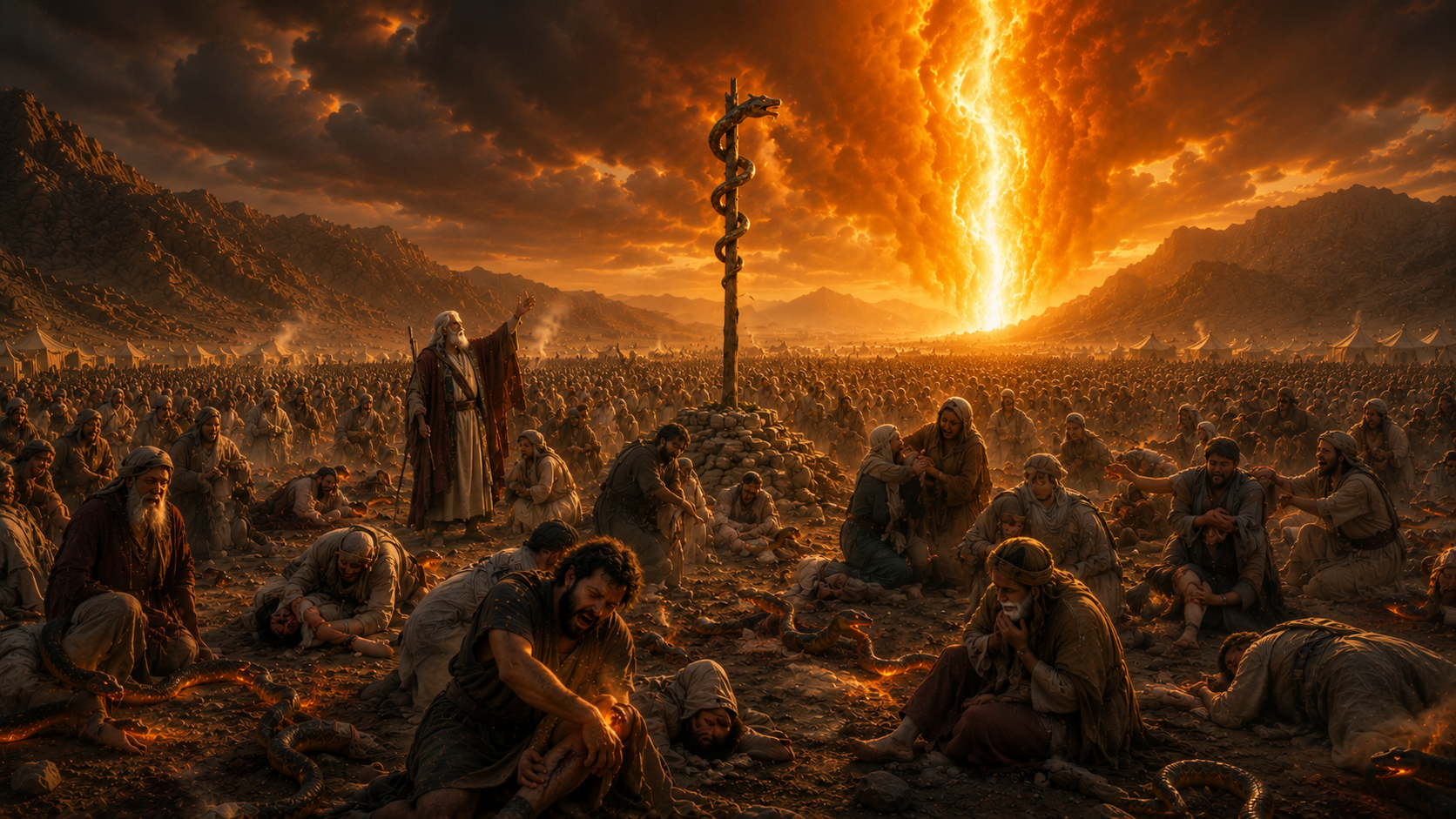
Then the snakes came.
“And the LORD sent fiery serpents among the people, and they bit the people; and much people of Israel died.”
—Numbers 21:6
We are not under that covenant today. God is not sending sickness, financial trouble, marriage problems, flat tires, difficult children, or other forms of suffering to punish Christians for complaining. Jesus already bore our judgment at the cross. It would be illegal if God judged you for your sin, since Jesus was already judged and punished for them.
But there is still a principle here we shouldn't miss:
When complaining becomes your perspective, the snakes of life will eventually come for you.
Galatians tells us that God is not mocked: whatever a person sows, that is what he will reap. We still live in a world of seed and harvest.
A consistently negative perspective produces something.
Complaining changes how you see your spouse. It changes how you interpret your circumstances. It changes what you notice about your job, your church, your children, your future, and eventually even God.
Fear does the same thing.
Some people excuse negativity because they're afraid. But whether it comes from fear, disappointment, bitterness, or frustration, if you continually train yourself to look for what's wrong, you will become incredibly good at finding it.
Eventually, what is happening inside of you begins producing something outside of you.
The snakes of life come in different forms.
Maybe the snake is bitterness. Maybe it's a marriage slowly deteriorating because every disagreement becomes an opportunity to blame the other person. Maybe it's insecurity that causes you to manipulate people. Maybe it's fear that keeps producing bad decisions.
Maybe it's resentment, lust, anger, isolation, cynicism, or a constant dissatisfaction that makes it impossible to enjoy what God has already put in your life. Sometimes we're asking God to remove a snake that our own attitudes and decisions keep feeding.
That's why gratitude is so powerful.
Gratitude trains your eyes to recognize grace. Complaining trains your eyes to recognize lack.
Israel had manna on the ground, water available, freedom from Egypt, and the presence of God in their midst—and still concluded that they had nothing.
That's what complaining can do to the soul.
Look and Live
When Israel finally recognized what was happening, they came to Moses and said, “We have sinned, for we have spoken against the LORD, and against thee.” They asked Moses to pray that the serpents would be taken away (Numbers 21:7).
God's answer is fascinating.
“And the LORD said unto Moses, Make thee a fiery serpent, and set it upon a pole: and it shall come to pass, that every one that is bitten, when he looketh upon it, shall live.”
—Numbers 21:8
Moses made the bronze serpent, lifted it up, and Numbers 21:9 says that when someone who had been bitten “beheld the serpent of brass, he lived.”
They looked and lived.
God did not tell the bitten person to prove that he had changed. He didn't require him to keep the Law perfectly for seven days before healing him. He didn't tell him to make up for every complaint he had made.
He gave him something to look at.
Thousands of years later, Jesus is having a conversation with Nicodemus, a teacher of Israel who understood Torah, Law, sacrifice, priesthood, and righteousness.
And Jesus takes Nicodemus directly back to this story:
“And as Moses lifted up the serpent in the wilderness, even so must the Son of man be lifted up: That whosoever believeth in him should not perish, but have eternal life.”
—John 3:14–15
Then Jesus makes the statement that has become the most famous verse in Scripture:
“For God so loved the world, that he gave his only begotten Son, that whosoever believeth in him should not perish, but have everlasting life.”
—John 3:16
And He continues:
“For God sent not his Son into the world to condemn the world; but that the world through him might be saved.”
—John 3:17
Jesus preached faith righteousness.
Look and live.
Believe and receive.
What Are You Looking At?
Later Jesus returned to the imagery of being lifted up:
“Now is the judgment of this world: now shall the prince of this world be cast out. And I, if I be lifted up from the earth, will draw all men unto me.”
—John 12:31–32
The cross becomes the place where we look.
Christ became the curse for us. He bore our sin. He entered into death. He took upon Himself what separated humanity from God and defeated it through His death and resurrection.
So when the snakes of life come for you, the answer isn't to spend the rest of your life staring at the snakes.
Look at Christ.
This is where Christianity has to become more than information.
Hebrews says:
“For the word of God is quick, and powerful, and sharper than any twoedged sword… and is a discerner of the thoughts and intents of the heart.”
—Hebrews 4:12
Don't just read the Word. Let the Word read you.
Ask yourself what your reactions are revealing.
Why am I so angry?
Why am I constantly offended?
Why am I afraid?
Why do I need everyone to approve of me?
Why do I keep manipulating situations?
Why do I keep sabotaging relationships?
Why can I walk into a room with a hundred things going right and immediately notice the one thing that's wrong?
Those are snakes worth identifying.
But once you identify them, don't make the snake your meditation.
Look to Jesus.
The areas where you're still struggling are often the areas where you need to see Him more clearly.
If you're insecure, look at the cross until you see your value.
If you're bitter, look at Jesus until you understand how completely you've been forgiven.
If you're afraid, look at Him until His faithfulness becomes more real than what you're afraid of.
If you're hurting people because you're hurting, look at how Christ has loved you until His love begins healing the place inside you that keeps producing destruction.
This isn't merely behavior modification.
It's transformation through beholding.
Don't Call the Manna Worthless
One of the saddest parts of Numbers 21 is that the Israelites were surrounded by miracles and couldn't see them anymore.
The manna had become ordinary.
The provision had become expected.
The presence of God had become familiar.
And familiarity turned into ingratitude.
We can do the same thing with the gospel.
We can become so accustomed to hearing that we're forgiven, righteous in Christ, reconciled to God, filled with His Spirit, and destined for eternal life that we start looking for something more exciting.
Don't call the manna worthless.
Don't let the gospel become boring.
Daily grace is miraculous. Daily communion with God is miraculous. Having the Spirit of God dwelling within you is miraculous. Knowing that your name is written in heaven is miraculous.
Learn to enjoy today's bread.
Learn to recognize God's goodness again.
Learn to be grateful for what is already in your life instead of continually rehearsing what isn't.
Because complaining has a cost.
If you spend your life looking for what's wrong, eventually the snakes of life will come for you.
But when they do, don't stare at the snakes.
Don't stare at your failure.
Don't stare at your circumstances.
Don't stare at everything that's wrong.
Lift your eyes.
Look at the One who became the curse for you.
Look at the One who bore your sin.
Look at the One who loved you enough to enter into death and bring you out of it.
See your value in Him. See your righteousness in Him. See His kindness, patience, purity, faithfulness, strength, and love.
And let what you see in Him change what is happening in you.
Gratitude keeps your eyes on grace. Complaining keeps your eyes on lack.
So when the snakes of life come for you, remember the simplicity of the gospel:
Look to Jesus and live.
Discussion Questions
Where have you seen complaining or consistently focusing on what’s wrong become a “snake of life” that produces consequences in your attitude, decisions, or relationships?
What does it practically look like to “look to Jesus” in an area where you’re currently struggling rather than continually looking at the problem?
Israel became so familiar with God’s daily provision that they called the manna worthless. What has God already provided in your life that you may need to recognize again with fresh gratitude?
Granddaddy's favorite
Attending Pete's funeral reminded me that the Church is at its best when it feels like family, where people are deeply known and genuinely loved. When we love one another the way Christ has loved us, we give the world a reason to say, "I want to be part of that family."
I attended a funeral recently that reminded me what the Church is supposed to look like.
It was the celebration of life for Pete Cavendar. What made the service so memorable wasn't a polished eulogy. Instead, one by one, his grandchildren stood up and shared stories. Some had prepared a few thoughts, others spoke off the cuff, but as I listened something became obvious. Every one of them thought they were Granddaddy's favorite.
As I listened to his family members lovingly remember him, I caught myself thinking. I wish he were my grandaddy too so I could be part of that family. That this is exactly what Jesus intended His Church to be, a family that loves well and compels others to want Jesus because of how we love one another.
Showing the World God’s Love
"Beloved, let us love one another: for love is of God... Beloved, if God so loved us, we ought also to love one another. No man hath seen God at any time. If we love one another, God dwelleth in us, and his love is perfected in us." (1 John 4:7, 11-12)
Think about that. No one has seen God, but people can see His character through His children.
That's what I witnessed at Pete's funeral.
Those grandchildren weren't talking about theology. They weren't explaining doctrine. They were simply describing a man who consistently loved them, and through that love they caught a glimpse of the Father's heart.
Jesus prayed something remarkable in John 17. He asked the Father that His followers would become one, "that the world may believe that You sent Me." We often think miracles are what convince people Jesus is real, and certainly God still heals and works powerfully today. But Jesus Himself pointed to something even greater.
Our love for one another.
The world should be able to look at the Church and say, I want to be part of that family.
Honestly, that's exactly what I found myself thinking during that service. Watching those grandchildren laugh, cry, tell stories, and honor their Granddaddy made me think, This is what people are looking for.
People are hungry for family.
They're looking for a place where they're known, valued, and loved. They want someone who notices them, believes in them, and makes them feel like they matter.
The Church should be that place.
Not because we've built better programs, but because we've learned to love each other the way Christ has loved us.
John continues,
"There is no fear in love; but perfect love casteth out fear... We love him, because he first loved us." (1 John 4:18-19)
Everything begins there. We don't manufacture love. We receive it. We allow ourselves to be convinced that God truly loves us, and then that love begins to overflow into the lives of others.
Forgiveness
Sometimes the greatest act of love is simply forgiving those who have wounded us. The cross made that possible. Jesus bore our sin so we could release the sins committed against us. As His love matures in our hearts, we're no longer defined by our wounds. We're free to love people—even imperfect people—the way we've been loved.
When that happens, the Church becomes something the world can't ignore.
Imagine a church where every person who walks through the doors leaves feeling like Pete's grandchildren did—that somehow they were seen, known, and deeply loved.
Imagine neighborhoods where believers consistently serve one another without needing recognition.
Imagine businesses run with integrity, families marked by forgiveness, and friendships defined by faithfulness.
That's the witness Jesus envisioned.
My prayer after attending that funeral is simple: may the people around us experience the love of God so clearly through our lives that they don't just believe the gospel is true—they want to become part of the family that lives it.
Change Your Thoughts, Change Your Life
The cross is the lens everything else should be filtered through, and your real fight is usually with a destructive thought loop, not an outside force — so when a hard thought hits, name it and replace it with truth (rejection with acceptance, guilt with forgiveness, shame with grace). Isaiah 53 spells out that trade in detail, showing how his suffering directly answers your specific struggles. And don't keep asking "what's wrong with me" — your mind finds whatever evidence you keep hunting for, so choose to see your same circumstances through a hope-filled lens instead.
You Don't Have to Believe Every Thought You Think
Ever notice how a bad thought can snowball? One small "what's wrong with me" turns into a full-blown spiral before lunch. Here's the good news: you're not stuck with those thoughts, and you're not fighting them alone.
That's the heart of a simple but powerful idea: everything you believe about God, and about yourself, has to be filtered through what Jesus did on the cross. Not as a slogan you nod along to, but as the actual lens you run your thoughts through when life gets loud.
The One Thing Everything Else Builds On
Scripture, church history, doctrine — all of it matters. But there's one center of gravity holding it together: the death, burial, and resurrection of Jesus. Every question you're wrestling with, every fear, every "why is this happening" — it's all meant to be understood in light of what happened at the cross. That's not the whole Bible reduced to one idea; it's the foundation everything else is built on.
Your Real Fight Isn't With Demons — It's With a Thought Loop
Here's a shift in perspective worth sitting with: the "spiritual warfare" described in 2 Corinthians 10 isn't primarily about casting out evil spirits. It's about tearing down strongholds — and a stronghold is just a repeating, destructive way of thinking. Things like:
"I always attract this kind of situation."
"I don't deserve this."
"Something's wrong with me."
That loop, left unchecked, is what the passage calls carnal thinking — thinking that leads to death, not because you're a bad person, but because it's disconnected from the truth. The fix isn't gritting your teeth harder. It's taking the thought captive — noticing it, naming it, and refusing to let it run the show.
So what do you replace it with? This is the key move: you bring the thought into line with what Christ was obedient to — his death on the cross. Practically, that looks like:
Condemnation gets answered by righteousness.
Fear gets answered by perfect love.
Shame gets answered by forgiveness.
Rejection gets answered by reconciliation.
Hopelessness gets answered by the hope of eternal life.
You're not pretending the hard feeling isn't there. You're just refusing to let it have the final word.
Isaiah 53: A Snapshot of the Trade
Isaiah wrote this roughly 700 years before Jesus was born, and it maps the cross with eerie precision. Strip away the specific verses and you're left with one simple exchange, repeated over and over:
He was rejected — so you could be accepted.
He carried grief — so your grief could be met, not ignored.
He was wounded — so guilt and condemnation lose their grip on you.
He was silent under false accusation — so you don't have to defend or perform your worth.
He was cut off — so no place you've ever been, emotionally or otherwise, is a place he hasn't already gone to break its power.
None of this erases real pain — grief is still grief, loss is still loss. But it means you're never carrying it solo, and it's never the deepest truth about you.
Don't Talk to Yourself Like Someone Who Isn't Loved Like This
If you wouldn't let a friend talk to you the way you talk to yourself, that's worth noticing. Beating yourself up isn't humility — it's actually a mismatch with what all of this claims is true about you. You're not disqualified. You're not too far gone. You're not the exception. That's a hard thing to actually believe in the middle of a bad week, but it's the whole point.
Watch What Question You're Asking Yourself
There's a subtler trap worth naming: asking "what's wrong?" on repeat. It sounds harmless, even self-aware. But your mind will always find an answer to the question you keep asking it. Ask "what's wrong with me" enough times, and you'll start seeing evidence for it everywhere — in your relationships, your job, your body, your past decisions. It becomes a self-fulfilling filter.
The alternative isn't denial. It's asking a better question: what does the truth say here, not just my circumstances? That's the difference between carnal thinking (only what you can see and figure out on your own) and spiritual thinking (holding onto a promise even when you don't yet see how it works out).
Send Me Everything You've Got
There's an old story about two salesmen sent to an island where nobody wears shoes. One calls home defeated: "Waste of time, nobody needs shoes here." The other calls back thrilled: "Nobody has shoes — send me everything you've got, this is the opportunity of a lifetime."
Same island. Same facts. Completely different outlook — because they were looking at the same thing through a different lens. That's the invitation here: you already carry everything you need on the inside. The question is just which lens you're looking through today.
Takeaways
Everything you believe about God and yourself should be filtered through the cross — it's the foundation, not just one topic among many.
Your real battle is usually with a thought pattern, not an outside force. Name the loop instead of just feeling stuck in it.
"Taking a thought captive" means noticing the destructive thought and deliberately replacing it with truth — condemnation with righteousness, fear with love, shame with forgiveness, rejection with reconciliation, hopelessness with hope.
The exchange at the cross applies personally: rejection, grief, guilt, and isolation were all addressed there.
Don't talk to yourself in a way you wouldn't accept from someone else.
Be careful what question you keep asking yourself — "what's wrong with me" tends to manufacture its own evidence.
Same circumstances, different lens, completely different life. You get to choose which one you're using.
Try This
Next time a hard or self-critical thought shows up, don't just push through it — interrupt it on purpose:
Name it. Say what the thought actually is: "I'm thinking I'm not enough," or "I'm thinking this is my fault."
Ask the real question. Not "what's wrong with me," but "what's actually true here?"
Replace it, out loud if you can. Pick the matching truth — "I'm forgiven," "I'm not carrying this alone," "This isn't the final word" — and say it like you mean it, even before it fully feels true.
That's it. Small, repeatable, and it works exactly because it's simple.
Mystical Placebo vs Mature Faith
A mystical placebo is any ritual, special anointing, or spiritual condition inserted between you and what Christ has already provided — and like a sugar pill in a clinical trial, it can appear to work because your faith and expectation finally had somewhere to land, not because the ritual itself had any power. The trap is that you walk away dependent on the mechanism instead of the source, endlessly chasing the next evangelist, the next formula, or the next loophole to unlock what Jesus already paid for in full. Mature faith cuts through all of it — rooted in the finished work of Christ, it simply recognizes that healing, freedom, and abundant life aren't rewards you earn through the right spiritual steps, but a reality you receive by becoming fully persuaded that he who promised is faithful.
What Is a Placebo and What Makes One "Mystical"?
A placebo is something that has no actual medicinal power, but because you believe it does, it works anyway.
Here's the classic example: In a clinical drug trial, researchers give half the participants the actual medication and the other half a simple sugar pill, a fake. The sugar pill has zero pharmacological effect. And yet, time and again, some of the people who took the sugar pill experience the same results as those who took the real drug. Not because the pill did anything. Because they believed it would.
This is medically verified. It's documented. It's real.
Now, God wired us this way. Your beliefs have genuine power over your physical and emotional reality. What you keep saying shapes what you keep expecting. What you keep expecting shapes what you experience. That's not mysticism. That's how we're made.
But here's where it gets dangerous in the church.
A mystical placebo is when a spiritual condition, ritual, or authority figure gets inserted between you and what Christ has already provided, and people get results not because the ritual worked, but because their faith and expectation finally had somewhere to land.
The "miracle" was real. But the mechanism was misidentified.
The Lineup of Mystical Placebos
They show up in more forms than you might think.
Special anointings. The idea that certain teachers or evangelists carry a supernatural power that you don't have, and if you can just get under their ministry, receive their impartation, or align yourself under the right covering, then you'll get what God has for you. This is textbook Gnosticism — the ancient heresy that plagued the early church and that Paul and John wrote letters to combat. The word "Gnosticism" comes from the Greek gnosis, meaning knowledge. The pursuit of the missing piece. The special information that will finally make you complete.
Healing pools and blessed objects. Think of the Pool of Siloam, where the legend held that an angel would stir the waters and the first person in would be healed. People were healed there. But were they healed because of the water, or because the water gave their faith somewhere to focus? There's a difference. And confusing the two is how people end up writing $770 checks on the seventh day of the seventh month at 7 PM because someone told them God attached a tenfold blessing to that specific combination.
"You can't be healed until you forgive." This one is especially pervasive in inner healing circles. The idea is that an unresolved soul tie, a generational curse, or unforgiveness gives the enemy a "legal right" to block your healing. On and on the list goes: your grandfather was a mason, you said a bad word after stubbing your toe, you've slept with too many people. There's no end to the mystical legal loophole. You can spend your whole life trying to diagnose the spiritual technicality that's standing between you and your breakthrough.
And exhausting doesn't begin to cover it.
Why It "Works"
Here's what makes mystical placebos so hard to call out: people actually get healed through them.
The evangelist prays, the crowd erupts, someone's pain disappears. The baptism pool fills up, someone goes under, they come out changed. The oil-soaked Bible gets pressed to a forehead, and something happens.
So how do you argue with results?
Very carefully, because the results are real, but the explanation may be wrong.
When someone creates an environment of expectation — if I can just get to that service, if I can just get in that water, if I can just get that man of God to pray for me — they have, whether they know it or not, done something powerful. They have persuaded their own heart. They have built up hope to the point of confident expectation. And when a heart is fully open, the healing that Christ already paid for can finally find a place to land.
The miracle came from Christ. But the person was told it came from the ritual. And now they're dependent on the ritual, and on the person or process that provides it.
That's the trap.
The Woman with the Issue of Blood
Mark 5 gives us the clearest picture of how this actually works.
A woman had been bleeding for twelve years. She'd spent everything she had on doctors. She was ceremonially unclean, which meant she wasn't legally allowed in public, let alone touching a man. Approaching Jesus in that crowd could have gotten her arrested. Could have gotten her stoned.
And yet she came.
"When she heard about Jesus, she came up through the crowd behind him and touched his cloak. For she kept saying, 'If only I touch his garments, I will be healed.'"
Notice what she kept saying. She was programming her heart. She was building expectation, layer by layer, through repetition of a belief she was still in the process of owning.
And then: "Immediately her bleeding stopped, and she sensed in her body that she was healed of her affliction."
She took it. Jesus didn't see her coming and decide to heal her. He didn't even know who touched him. "At once Jesus was aware that power had gone out from him. Turning to the crowd, he asked, 'Who touched my garments?'"
Power went out from him because she drew from him. He is the source, not his garment — not a placebo, not a symbol, but the actual thing. And she accessed it through faith before he ever made a conscious decision in her direction.
His response when he finally found her?
"Daughter, your faith has healed you. Go in peace and be free from your affliction."
Not: "Good thing you touched me." Not: "Your ritual worked." Not: "You finally found the right loophole."
Your faith has healed you.
Now, she did put a stipulation on it. If only I touch him. What if she had believed from her sick bed, without ever reaching the crowd? Would healing have been just as available? Almost certainly. She may have received through a slightly more elaborate path than necessary, but she got there. The mechanism that actually mattered was the persuasion of her heart.
Faith Is Not What You Do to Get God to Move
This is the hinge point that changes everything.
Faith is not an action you perform to trigger a divine response. It's not the lever you pull. It's not the checklist you complete. It's not even the feeling you have to manufacture.
"Now faith is the substance of things hoped for, the evidence of things not seen." — Hebrews 11:1
Faith is the foundation. It's the bedrock that opens your heart to receive what is already present and available. Think of it like a building: faith pours the foundation — Christ, the solid rock. Then hope — confident expectation, not wishful thinking — begins to build on that foundation.
Hope is not "I really wish this would happen." Hope is: He died for this. He overcame sin. He destroyed death. He took my diseases on that cross. I don't care what my body is saying right now. He is a healer. That is settled.
Nobody can argue you out of that. No bad test result shakes it. No symptom distracts it. It is resolute.
Why do you have the right to that kind of confidence? Because he is the source. The question is never whether he's able or willing. The question is always how clearly you see him.
Sarah and the Tipping Point
Consider Abraham and Sarah. God spoke the promise: through you will come a blessing that blesses all nations, you will have a child, and then nothing happened for twenty-five years.
The promise was real. The promise was present. It was, in a sense, hanging in the air, charged and available, trying to find a place to land in her heart. But until Sarah judged him faithful — until she fully believed that the one who promised was actually capable of delivering — she couldn't receive it.
"He who promised is faithful." — Hebrews 10:23
That was the tipping point. Not a ritual. Not a confession formula. Not a special impartation. She finally saw him clearly. And the moment she did, what he had spoken from the beginning simply became her reality.
God didn't withhold the promise until she believed. She couldn't receive it until she did.
So What Do We Actually Do?
Keep saying the truth, not to make it happen, but until you actually believe it.
Confession isn't a magic formula to trigger God's action. It's the discipline of repeatedly presenting truth to your own heart until your heart finally accepts it. By his stripes, you were healed. He is your provider. He is faithful. Not "will be" — is. You're not trying to move him. You're trying to get yourself to believe that he's already moved.
Repentance, in its deepest sense, isn't just apologizing — it's seeing him clearly. And when you see him clearly, something happens that you can't fully explain or manufacture: you become like what you behold. When you see him as merciful, you become merciful. When you know you're forgiven, you can forgive. When you see him as a healer who wants you well, your heart opens and lets the healing through that was always there.
You are not a project God is stalling on. You are not a loophole he's waiting to close. You are not incomplete, unchurched enough, or under the wrong covering.
You are complete in him. The anointing abides. His Spirit is in you. The same power that raised Jesus from the dead is at work in your physical body right now.
Stop chasing. Start receiving.
"Let us hold resolutely to the hope we profess, for he who promised is faithful." — Hebrews 10:23
What Does it Mean to Bring Your Thoughts Captive to Christ’s Obedience?
Through the death, burial, resurrection, and Pentecost, God made it possible not only to forgive us but to remove our old sinful nature, give us a new heart, place His Spirit within us, and make us new creations in Christ. Because God's Spirit now lives in us, we are no longer victims of our thoughts but have the ability to bring every thought captive and evaluate it in light of what Jesus accomplished through His obedience on the cross. Lasting transformation happens when we consistently replace thoughts that contradict the Gospel with the truth of who God is, what Christ has done, and who we now are in Him.
Capturing Thoughts and Living in Freedom
Pentecost was more than a dramatic moment in the book of Acts. It marked a permanent change in how God relates to humanity. Before Christ's death and resurrection, the Spirit of God would come upon prophets, priests, and kings for specific purposes. Under the New Covenant, God fulfilled His promise to put His Spirit within His people (Ezekiel 36:25-27; Jeremiah 31:33; Acts 2:1-4).
Jesus instructed His disciples to wait for "the Promise of the Father" (Acts 1:4-5). That promise was not merely power—it was presence. The Spirit of God would no longer simply rest upon His people. He would dwell within them.
"Pentecost marked the day when God changed locations and moved into His believers."
This truth changes everything about how we view ourselves. We are not trying to get God to come near. Through Christ, He has already made His home within us. Paul asks the question in 1 Corinthians 6:19, "Do you not know that your body is the temple of the Holy Spirit who is in you?" The presence that once filled the tabernacle and the temple now lives within every believer.
The Christian life begins with understanding that God is not distant. He is present. He is near. He is in you.
What God Did in You
When you believed the Gospel, God did more than forgive your sins. He performed a supernatural work in your spirit. Colossians 2:11-13 describes this as a spiritual circumcision, a removal of the old sinful nature. Ezekiel prophesied that God would remove the heart of stone and give us a heart of flesh (Ezekiel 36:26).
The old nature that was dead in sin was removed. Through the blood of Christ, you were washed, cleansed, sanctified, and made alive in Him (Hebrews 10:10, 14; Titus 3:5; Ephesians 2:4-6).
"You are not a sinner trying to become righteous. Through faith in Christ, you have been made righteous and are learning to live from that reality."
God did not merely improve the old you. He created something entirely new.
2 Corinthians 5:17 declares:
"If anyone is in Christ, he is a new creation; old things have passed away; behold, all things have become new."
The Gospel is not behavior modification. It is spiritual transformation.
The Battle Is Not Your Thoughts—It's Your Agreement
Every person experiences unwanted thoughts. Fearful thoughts. Tempting thoughts. Condemning thoughts. The presence of a thought does not define you. What defines you is whether you choose to agree with it.
Scripture teaches that believers have the ability to bring thoughts into captivity (2 Corinthians 10:3-5). This means we are not helpless victims of our thinking. Through the Spirit of God, we can evaluate every thought and determine whether it belongs in our lives.
"You cannot stop every thought from arriving, but you can stop it from taking root."
A stronghold is not merely a demonic attack. A stronghold is a belief that has become established in the heart and exalts itself against the knowledge of God. The enemy may reinforce that lie, but the lie itself is what must be torn down.
This is why mind renewal is so important. Transformation begins when truth becomes more believable than the lie.
Bringing Every Thought to the Cross
Paul tells us to bring every thought captive to the obedience of Christ (2 Corinthians 10:5). Many believers read that verse and assume it means making their thoughts obey Jesus. While that is partly true, there is something deeper taking place.
Romans 5:19 says:
"By one Man's obedience many will be made righteous."
The obedience of Christ refers to His obedience unto death, even the death of the cross (Philippians 2:8).
Every thought should be evaluated in light of what Jesus accomplished through His obedience.
When fear says, "God has abandoned me," we bring that thought to the cross. Jesus suffered to reconcile us to the Father (Romans 5:10). Therefore, that thought is a lie.
When shame says, "I am unworthy," we bring that thought to the cross. Jesus became sin so that we might become the righteousness of God in Him (2 Corinthians 5:21). Therefore, that thought is a lie.
When temptation says, "This is who I am," we bring that thought to the cross. Christ crucified the old man and raised us into newness of life (Romans 6:4-6). Therefore, that thought is a lie.
"Take every thought through the death, burial, and resurrection of Jesus until it agrees with what He accomplished."
That is how strongholds lose their power.
Your Heart Determines Your Reality
Scripture consistently teaches that the heart is the center of belief.
"As a man thinks in his heart, so is he" (Proverbs 23:7).
"Guard your heart with all diligence, for out of it spring the issues of life" (Proverbs 4:23).
The beliefs that take root in your heart shape how you see yourself, how you interpret circumstances, and how you respond to temptation, fear, and adversity.
If your heart is convinced that God loves you, you will respond differently to life's challenges.
If your heart is convinced that you are accepted in Christ, condemnation loses its influence.
If your heart is convinced that you are a new creation, sin loses much of its appeal.
"The battle is not merely about behavior. The battle is about what feels true in your heart."
This is why meditation on God's Word is so powerful. It moves truth from information into conviction.
Think on These Things
Paul gives believers a practical filter for every thought:
"Whatever things are true, whatever things are noble, whatever things are just, whatever things are pure, whatever things are lovely, whatever things are of good report... meditate on these things" (Philippians 4:8).
Every thought that enters your mind can be examined through these questions:
Is this true?
Does this agree with what Jesus accomplished?
Does this align with who God says I am?
Does this produce faith, hope, and love?
Does this magnify Christ or diminish Him?
"If a thought does not agree with the finished work of Jesus, it does not deserve permanent residence in your mind."
The goal is not positive thinking. The goal is agreement with truth.
As God's truth becomes established in your heart, peace begins to replace anxiety, confidence begins to replace fear, and freedom begins to replace bondage.
This is the pathway of transformation.
This is what it means to bring every thought captive to the obedience of Christ.

Alien Disclosure, UFO Files, and the Church
A deep dive into declassified FBI “Flying Disc” files reveals a strange mix of military reports, civilian sightings, alleged crash recoveries, and growing public fear during the late 1940s. The documents show that while many reports were likely explainable, the FBI and military still took the phenomenon seriously enough to investigate, catalog, and quietly coordinate responses across the country.
Why Christians Need Clarity in a World Full of Confusion
For most of modern history, UFOs were treated like a joke.
The subject lived somewhere between conspiracy theories, science fiction, tabloid magazines, and late-night radio. People who talked openly about aliens or unidentified flying objects were usually dismissed as paranoid, unstable, or gullible.
But something has changed.
Over the last several years, the United States government has openly admitted that unidentified aerial phenomena are real. Military pilots have testified publicly. Radar footage has been released. Congressional hearings have been conducted. Intelligence officials have acknowledged that there are objects operating in our skies that appear to move beyond known human technology and conventional physics.
And now entire government archives dedicated to UFO investigations are publicly accessible through official websites like War.gov.
That alone is historic.
But once you begin reading the actual files, you realize this story did not begin recently.
The government has been quietly documenting these encounters for generations.
The FBI Files Are Stranger Than Most People Realize
The newly available FBI records reveal that by 1947, federal agencies were already overwhelmed with reports of “flying discs.”
In one memo from Portland, Oregon dated October 9, 1947, witnesses described silver circular objects moving silently at tremendous speed across the sky. One observer estimated the craft traveled nearly 500 miles per hour and reflected sunlight with an unusual glow. Police officers and civilians alike submitted statements saying the objects maneuvered unlike conventional aircraft.
Another report from Anchorage, Alaska described a metallic object seen hovering in broad daylight over Bethel. Witnesses claimed it had no visible wings, made no sound, and accelerated rapidly before vanishing. The observer specifically stated it did not resemble any conventional aircraft.
In another declassified letter, a citizen directly asked the FBI whether “people living underground” could be connected to the flying saucer phenomenon.
That sounds bizarre now, but what’s fascinating is how quickly people associated the phenomenon with spiritual, underground, or non-human intelligence.
The files are filled with this tension:
government skepticism
unexplained observations
public fear
military concern
and ongoing uncertainty
Some sightings were dismissed.
Others clearly were not.
Even the FBI Didn’t Know What They Were Looking At
One of the most revealing patterns in the files is that the FBI repeatedly tried to distance itself publicly from UFO investigations while privately continuing to document them.
J. Edgar Hoover’s office often responded to citizens by saying UFO investigations were outside FBI jurisdiction and belonged to military intelligence.
Yet at the same time, FBI agents continued collecting witness statements, filing reports, forwarding intelligence to the Air Force, and documenting unusual incidents across the country.
In February 1948, the Air Defense Command issued a confidential directive ordering military personnel to immediately report all “flying disc” incidents because the phenomena were considered important enough to potentially affect national security.
That’s important.
This wasn’t merely treated as entertainment or public hysteria.
Military intelligence considered the phenomenon serious enough to formally track.
And when you read the actual witness descriptions, many sound remarkably similar to modern UAP reports:
metallic craft
silent movement
sudden acceleration
glowing objects
no visible propulsion
impossible maneuverability
Even more fascinating, a modern FBI interview from 2023 describes contractors witnessing a metallic gray object emitting intense white light while moving silently across the sky before suddenly disappearing. Witnesses stated it had no visible wings or exhaust and behaved unlike any drone or aircraft they had previously seen.
The language changed from “flying discs” to “UFOs” to “UAPs.”
But the descriptions themselves barely changed at all.
The Church Cannot Respond With Fear or Speculation
Now here’s where this becomes spiritually important.
As Christians, we cannot afford to respond to all of this with panic, obsession, or endless speculation.
Because honestly, a lot of believers are already drifting into unhealthy extremes.
Some people become consumed with conspiracy theories. Others attach every current event to end-times predictions. Others become fascinated with “hidden knowledge,” secret government meetings, underground bases, or prophetic timelines.
And while some of those conversations can be interesting, they can also become major distractions.
Jesus never called the church to become professional mystery hunters.
He called us to reveal Him.
That’s what matters most right now.
Because the world is becoming spiritually confused.
And if disclosure continues — which I personally think it will — people are going to start searching for answers beyond science. They’re going to ask spiritual questions:
Who are we?
What is consciousness?
Are there other beings?
Is humanity alone?
Is religion wrong?
Was Jesus just an advanced being?
That last one is where this gets very serious.
The Real Battle Is About the Identity of Jesus
One of the most dangerous narratives already spreading online is the idea that Jesus was not the eternal Son of God, but some kind of extraterrestrial teacher or advanced cosmic being.
And this is not fringe anymore.
Entire New Age systems are already teaching:
Jesus was an alien
Christ consciousness came from advanced civilizations
humanity is evolving spiritually through alien contact
salvation is enlightenment rather than redemption
Some narratives even claim ancient secret societies like the Knights Templar or Freemasons protected the “bloodline” of Jesus because He was supposedly connected to non-human intelligence.
That storyline is already forming.
And if governments eventually reveal physical evidence of non-human intelligence, millions of people will reinterpret Christianity through that lens.
The attack will ultimately target the divinity of Christ.
Because if Jesus can be reduced to merely:
an advanced being
a star seed
an enlightened alien
or a cosmic teacher
then He is no longer the eternal Word made flesh.
But Scripture is crystal clear.
John 1 says Jesus is the eternal Logos of God.
Colossians says all things were created by Him and for Him.
He is not part of creation.
He is Lord over creation.
Genesis 6, the Nephilim, and the Spiritual Layer
This is why many Christians eventually end up studying Genesis 6 and the Nephilim when discussing UFO phenomena.
Genesis 6 describes the “sons of God” taking human women and producing offspring known as the Nephilim.
Ancient Jewish writings like the Book of Enoch expand on this narrative and describe fallen spiritual beings corrupting humanity, teaching forbidden knowledge, and producing giant hybrid offspring.
The Bible itself repeatedly references giants:
Goliath
Og king of Bashan
the Anakim
the giant clans in Canaan
And nearly every ancient civilization preserves myths about heavenly beings producing demigods or giant rulers:
Greek mythology
Egyptian mythology
Babylonian legends
the Epic of Gilgamesh
Many Christians believe the disembodied spirits of these Nephilim became what we now call demons.
Whether every detail of that theory is correct or not, Scripture absolutely teaches:
there was a supernatural rebellion
there are fallen spiritual beings
and there is real spiritual deception operating in the earth
Which means the church needs discernment, not fear.
The Goal Is Not Hidden Knowledge — It’s Christ
Personally, I do think the government knows far more than it has publicly admitted.
I think the declassified files prove that.
I think there are genuine unexplained phenomena happening.
I think some people inside intelligence communities are deeply concerned about what all of this means.
But none of that changes the central mission of the church.
Our assignment is not to endlessly decode mysteries.
Our assignment is to proclaim Jesus clearly.
Because ultimately, people are not saved by knowing conspiracy theories.
They are saved by hearing the gospel.
The Holy Spirit convicts hearts. The Holy Spirit reveals truth. We preach Christ. We plant seeds. And the Spirit works through that message to draw people into salvation.
The Kingdom of God Is Still Advancing
No matter what comes next — disclosure, deception, technological breakthroughs, spiritual confusion, or even genuine supernatural manifestations — one thing remains unchanged:
Jesus Christ reigns.
Isaiah says the government rests upon His shoulders.
1 Corinthians 15 says He is reigning until every enemy is placed beneath His feet, the final enemy being death itself.
That is the narrative believers must stay anchored in.
Not fear.
Not sensationalism.
Not endless speculation.
The kingdom of God is advancing.
And honestly, if the world begins asking deeper spiritual questions because of UFO disclosure, this may become one of the greatest opportunities the church has ever had to clearly reveal who Jesus truly is.
Because when people realize the universe is stranger than they thought, many become far more open to hearing about the One who created it all.